How The West Midlands' Triple Helix Model Enables AI Adoption

The West Midlands gives companies a practical route into AI adoption through its Triple Helix approach.
The region connects university research, industry expertise and public sector support to overcome commercial challenges.
Across manufacturing, data analysis, and product development, AI is rewriting how businesses operate. Companies need to innovate quickly, but cannot do so in isolation. Those located in regions capable of bringing together research, skilled people and commercial application at scale are those that will navigate this new frontier of tech.
The West Midlands’ advantage is that these conditions are not treated separately. Through its Triple Helix approach, university research, business demand and public sector support are brought into closer alignment.
Why the West Midlands is built for AI adoption
The West Midlands brings together the three conditions companies need to adopt AI effectively – research expertise from universities, practical use cases from industry and public sector support that helps coordinate skills, infrastructure and investment.
The region hosts approximately 180 AI firms, with 59 new businesses established in the first 10 months of 2025. The West Midlands also secured 130 foreign direct investment projects in 2024–25, the highest outside London, reinforcing its status as the second leading UK destination for innovation-led growth.
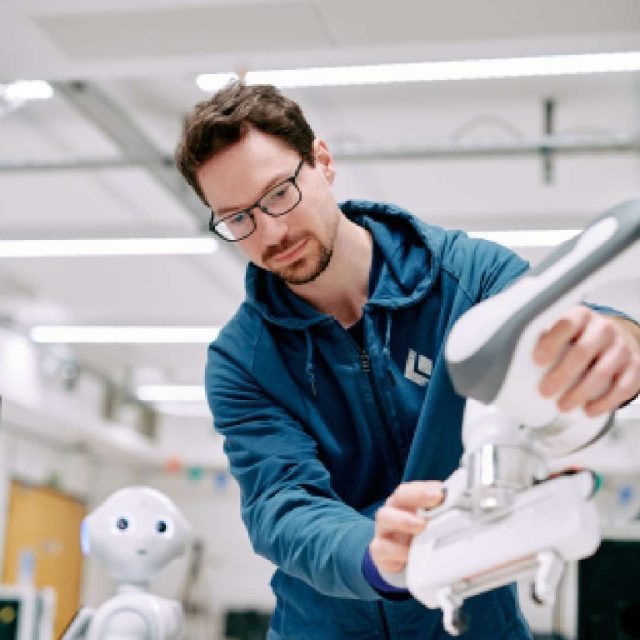
Warwick Manufacturing Group shows the Triple Helix model in practice. Its Centre for Applied Artificial Intelligence focuses on helping businesses deploy AI in practical commercial settings. Rather than concentrating purely on theoretical research, the centre works closely with industries on applications such as intelligent manufacturing, predictive maintenance, autonomous systems, data analytics, and digital transformation.
The West Midlands is also home to the UK’s first multi-city 5G testbed, giving businesses the infrastructure to develop and trial advanced AI, connected mobility and smart manufacturing technologies. This strengthens the region’s ability to support rapid innovation and commercial adoption at scale.
With lower operating costs than London, strong connectivity across the country, and access to a deep talent pool, the West Midlands is an increasingly attractive location for businesses seeking long-term growth through AI innovation.
AI Talent on Tap
The West Midlands is home to 10 universities and produces over 73,000 graduates annually. With one of Europe’s youngest populations (25% of the region’s population under 20) and strong graduate retention, the West Midlands maintains a steady pipeline of technical and creative talent in engineering, digital technology, science, and advanced manufacturing.
Aston University has launched a new master’s programme designed to help students understand how generative AI and emerging technologies are reshaping business models.
The MSc AI for Business Transformation course has been co-developed with industry partners. It will equip students with advanced knowledge of AI technologies and their commercial applications, helping them build the skills needed for an evolving job market.

But it’s not just the universities – public sector support is also being directed toward the skills challenge. A regional AI Academy designed to improve AI literacy, strengthen workforce capability, and help businesses access future digital skills at scale has been proposed by Richard Parker, Mayor of the West Midlands.
As AI becomes increasingly embedded in everyday life and business operations, organisations need people who can identify practical use cases, manage adoption, and turn emerging technologies into competitive advantage. These people are now being trained locally and will shape the business ecosystem in the coming years.
Blurring the line between business and research
The Triple Helix model depends on close links between research and business. In the West Midlands, universities are a driving force behind AI adoption and development. They work with companies, giving access to research expertise, commercially relevant talent and collaborative programmes shaped around industry need.
The Aston Centre for Artificial Intelligence Research and Application – based at Aston University in the Birmingham Knowledge Quarter – supports AI development in healthcare, sustainability, and industrial systems, while helping businesses adopt AI effectively.
The University of Birmingham helps businesses turn emerging technologies into practical advantage by connecting research expertise with real-world industrial challenges.

Through its Institute for Data and AI, the university brings together researchers across disciplines to advance data engineering, data science and AI. Its work spans areas directly relevant to industry, including smart manufacturing, advanced engineering, health, environmental resilience and digital governance, with external engagement and co-creation partnerships built into its model.
For companies in fast-moving markets, the West Midlands ecosystem reduces risk, accelerates product development, and improves access to specialist skills, supporting long-term growth.
AI in Action Across Industry
AI is already deployed across core industries in the West Midlands to improve efficiency, productivity, and competitiveness. The region excels at applying AI within established sectors:
- Grid Edge – a spin-out from Aston University, exemplifies AI innovation in the region. The company uses machine learning to help organisations reduce energy costs and carbon emissions in industrial and commercial buildings, integrating AI with sustainability-focused infrastructure management.
- Lexverify – applies AI and natural language processing to help organisations manage compliance risk in real time. Its technology automates risk detection across communications and documentation, illustrating AI’s growing role in enterprise technology and professional services.
- carbonTRACK – use intelligent energy systems and connected technologies to optimise energy consumption and improve building and infrastructure management.
The West Midlands is distinguished by its ability to apply AI technologies in live operational systems. Businesses collaborate directly with manufacturers, universities, customers and innovation centres to quickly test, refine and scale solutions.
How the West Midlands gives firms practical routes to AI adoption
Businesses in the West Midlands are close to advanced manufacturing supply chains, applied research centres and a growing base of digital and technology companies. For companies looking to adopt AI, that creates direct access to the expertise, partners and real-world environments needed to identify practical use cases.
The region’s 5G testbed, university-linked innovation hubs and applied research assets give businesses places to develop, test and validate AI-enabled technologies in real operating conditions.
That creates practical benefits for businesses looking to adopt AI, including:
- Lower adoption risk through testing and validation
- Easier collaboration with universities, manufacturers and applied research centres
- Access to technical talent with AI, data and engineering skills
- Clearer routes from early trials to operational deployment
That matters because AI adoption depends on more than buying software or experimenting with new tools. Companies need the right skills, data, technical support, sector knowledge and confidence to move from early trials into commercial use.
In the West Midlands, those conditions sit close together, helping businesses apply AI to productivity, operations, product development and customer insight with less friction.
The Future of AI Growth is in the West Midlands
AI companies need more than research strength. They need places to test, partners to collaborate with, industrial users to learn from and talent that can support commercial adoption.
The West Midlands brings those conditions together through its universities, applied research centres, advanced manufacturing base and public-private collaboration.
That makes the region a strong location for companies looking to develop, deploy and scale AI technologies in real industrial settings.