Hausbots

What if you could work at height without leaving the ground?
Painting a living room wall is not usually where a robotics business begins. But while decorating, one of Hausbots’ co-founders found himself thinking there had to be a better way.
What if, instead of somebody doing the painting, a robot could climb the wall and do it instead?
Beyond a Better Paintbrush
That idea became a university research project focused on a deceptively simple question: how do you make a robot stick to almost any wall?
The first instinct was still to improve the existing process. For painting, that might have meant a better tool – perhaps a paintbrush operated from the ground.
Then the team stepped back and changed the question. Rather than asking what would make the job better now, they began thinking about what inspecting and maintaining tall infrastructure would look like 50 years from now.
Would people still be hanging from bridges on ropes? Would they still be using scaffolding to inspect and maintain hard-to-reach infrastructure?
Hausbots concluded that the future probably wasn’t a slightly better paintbrush, harness or inspection tool. The bigger shift was removing the need for the person to go up there at all.
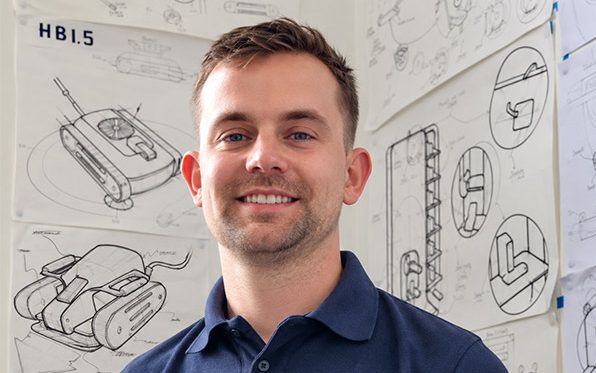
We were imagining a future where people stay on the floor and instead we send these tools to do the task.
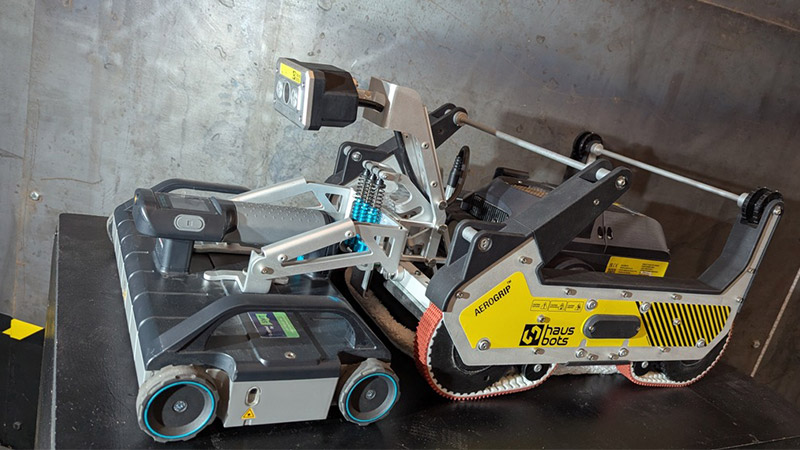
That thinking led Hausbots to develop crawler robots that attach directly to a surface and carry tools, sensors and equipment with them. The aim is to change where people need to be to carry out a task, rather than simply to make it more efficient.
Keeping people out of danger
One industrial project makes that shift tangible.
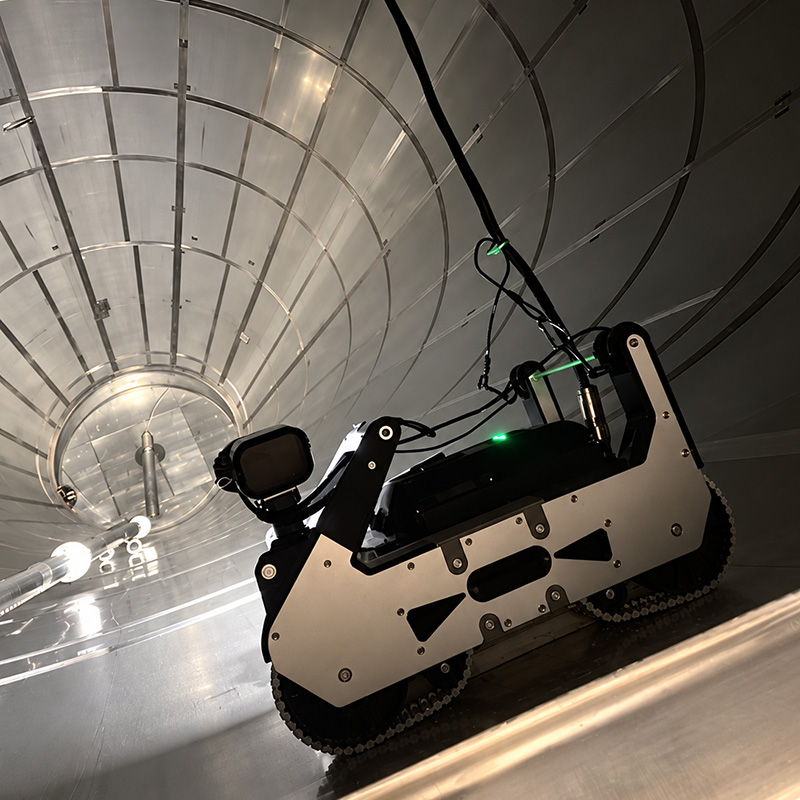
Hausbots is working with a customer on cleaning the inside of a storage tank that operates at around 80°C. Traditionally, the tank has to be stopped and allowed to cool to roughly 40°C before workers can enter and begin cleaning. Even then, because of the heat, the work is carried out in 10-minute shifts.
Hausbots offers a different approach. Its robot can be deployed at higher temperatures, allowing the cleaning process to begin sooner, while the operator remains outside the tank. The work can also be carried out more consistently and repeatedly without somebody having to enter the hazardous environment.
Built to go where people go
The same principle applies outdoors. On one coastal project, wind was gusting at around 60mph. The site owner told Hausbots that other methods – whether people or drones – would have lost the week because the weather was too severe. Attached directly to the surface, the crawler was still able to operate.
Versatility matters too. Conventional climbing robots have often relied on magnetic wheels, restricting them to suitable metal surfaces. Hausbots’ crawlers are designed to work across magnetic and non-magnetic materials, including concrete, steel, fibreglass, stainless steel and brick.
Birmingham made the prototype possible
From the beginning, Birmingham played a practical role in turning the idea into a product. Hausbots spent its early stage at Birmingham City University’s STEAMhouse, where access to prototyping equipment, workshop facilities and business support helped the founders build their first prototype.
We would never have been able to make our first prototype without access to STEAMhouse.
That prototype became an important turning point. It gave prospective customers something tangible to see and test, helping generate the early customer interest that then supported Hausbots in raising investment.
As the business developed, there were more reasons to stay. The West Midlands offered access to engineering talent, nearby manufacturers, suitable workshop space and universities with specialist expertise – the practical ingredients a hardware business needs as it moves from prototype to commercial product.
Warwick Manufacturing Group also supported Hausbots with early EMC testing as part of the certification process required to bring the product to market.
A lot of the components that go into the robots are manufactured locally, with local suppliers.
From Birmingham to the world
From that Birmingham base, Hausbots has built an increasingly international business. The majority of its revenue comes from overseas, with America its largest market, while its robots are being shipped to customers across Europe, Asia and beyond.
What began with a paintbrush and a living-room wall is now being applied to infrastructure around the world.
The breakthrough wasn’t simply finding a better way to climb but questioning why a person needed to climb in the first place.
The future Hausbots imagined was one where people stay safely on the ground, and the tools go up instead.
It Starts Here.